What if a more efficient brain–computer interface starts before the main processor?
In many BCI architectures, neural signals must be acquired, digitized, transferred and processed. Each stage can add complexity and power demands. That means improving efficiency is not only about adding more compute — it is also about rethinking what happens at the signal source.
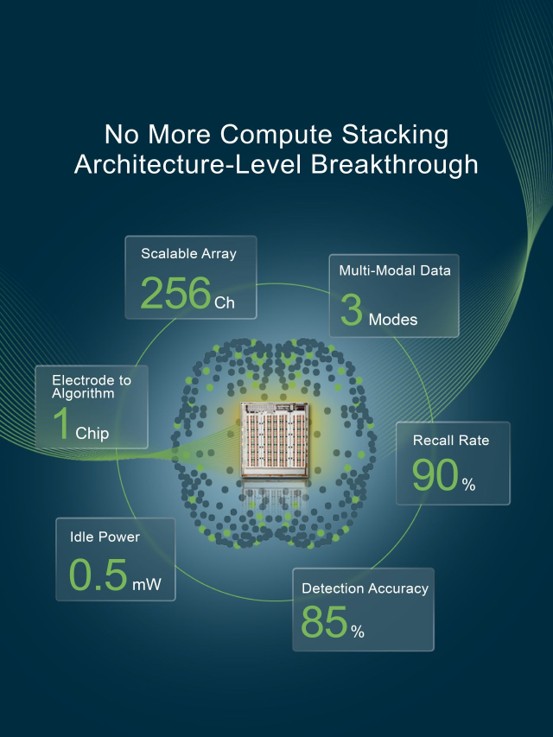
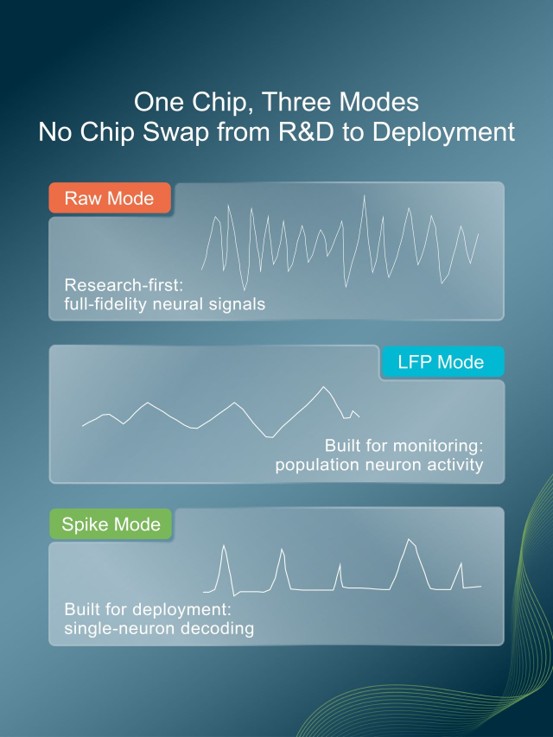
The Rigi™ series of neuromorphic neural signal acquisition chips is designed around this principle. One chip supports three complementary signal modalities:
• Raw — access to the original neural waveform for detailed analysis.
• LFP — local field potential signals that help researchers study population-level neural activity.
• Spike — single-neuron events for further neural signal processing.
Within a broader neuromorphic pipeline, Rigi™ focuses on neural signal acquisition and spike extraction, while Xylo™ provides low-power neuromorphic processing for bioelectrical signals. These complementary capabilities point toward a more efficient path from neural sensing to inference, depending on the system architecture and implementation.
From neuroscience research toward clinical translation and future BCI systems, the goal is not simply to add compute at the end. It is to make the signal chain more efficient from the start.
📫sales@synsense.ai
🌐 https://www.synsense.ai/