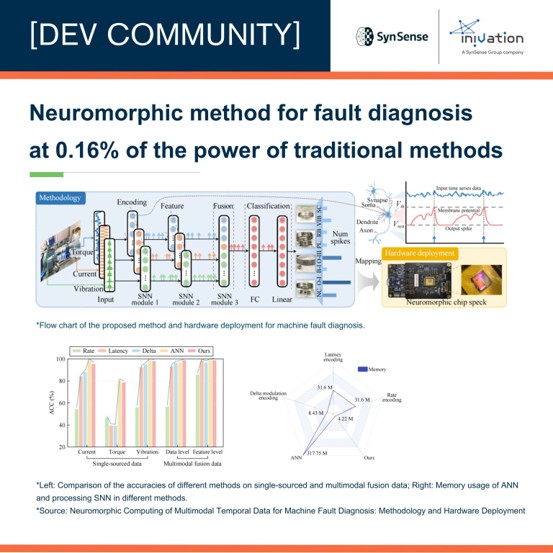
What if industrial fault diagnosis could run always-on without sacrificing energy efficiency?
A new study from Xi’an Jiaotong University, published in IEEE/CAA Journal of Automatica Sinica, proposes a neuromorphic method for machine fault diagnosis. Deployed on the SynSense Speck2e Dev Kit, the method fuses vibration, current, and torque data.
Key highlights:
· The neuromorphic method enables highly accurate fault diagnosis with ultra-low power consumption—only 0.16% of that of traditional computing methods.
· Multimodal fusion (especially at the feature-level) significantly improves accuracy over single-sourced data, achieving near-100% at the feature level.
· Memory footprint: 4.22 M, drastically lower than the 317.75 M required by the ANN baseline.
Why Speck™?
In this study, Speck™ achieves the lowest power, latency, and energy:
· Power: 1.30 mW vs. 829.01 mW (GPU) and 3192.03 mW (CPU)
· Latency: 6.01 ms vs. 6.71 ms (GPU) and 9.20 ms (CPU)
· Energy: 7.81 mJ vs. 5562.66 mJ (GPU) and 29,358.31 mJ (CPU)
Read the paper: https://ieeexplore.ieee.org/abstract/document/11595156
Authors: Weipeng Fan; Xiang Li; Yaguo Lei; Shupeng Yu; Naipeng Li; Bin Yang